
|
Recurrent Events
page H.001
[ Home ] [ Update ] [ Inside Moving Mountains ] [ Commentary ] [ About Us ] [ Advertising ] [ Join Us ][ Mountain Legacy ] [ Photos ] [ Blog ] [ Links ] [ Contact ]

DEPARTMENTS
A. The Hillary ModelB. Sport enterprise initiatives
C. Celebrity philanthropy
D. Promotional feats
E. Extremes
F. Team sports
G. Promotional events
H. Recurrent events
I. Global and regional games
J. Sport tourism
K. Diplomacy
L. Sport-Dev-Peace news
M. Dance
N. Martial Arts
O. Left Field
Recurrent sport events can have a significant impact on unestablished destinations. If a site is not yet famous in its own right, the event can put it on the map, establish the "brand," and reset the life cycle of a destination that might otherwise become tapped out.
Early on, the event may depend on the pre-existing charisma of the destination. Even if the event does not come to be more famous than the venue, it may become a significant part of the asset mix.
Bridges: Projects in Rational Tourism Development has proposed two such recurrent events. The program that was scheduled for Feb-May 2010 was to have focused on feasibility studies.
Heroes of Rolwaling A three-sport competition to be held regularly in Nepal's Rolwaling Valley. The first leg would be the ascent of one of the 20,000-foot trekking peaks -- either Yalung Tse or Ramdung. This would be followed by a 20-mile run from Tsho Rolpa, at the head of the valley, to Simigaon, down to the Bhote Khosi river, and upstream to the ethnically Tibetan village of Lamabagar. From there, the third leg would be a kayak race downstream to the roadhead near Dolakha.
The Everest Classic A backpacking marathon from the trailhead at Jiri all the way to Everest Base Camp, 100 miles away. (Alternatively, the route might begin 80 km further west at Lamosangu, which was the trailhead before the Swiss Road was completed as far as Jiri in 1985.) Competitors will be divided into classes according to the weights they carry: 7.5 (memba), 15 (trekker), or 22.5 kg (porter). Ideally, the weights would consist of rice or other staples that can be used locally.)
We're still hoping to move ahead with those projects.
In an upcoming article, we will look at the Tenzing-Hillary Everest Marathon, an event that we think deserves greater world-wide attention, and which could be a substantially greater force for development and for peace.
Why organize races?
Sporting events have important advantages over other forms of development.
- Because they are newsworthy, they generate free publicity.
- Although the competitive aspect of the events may be lacking in the usual recreational practice of the sports, competition and publicity provide an inspirational model that motivates recreation of the iconic event.
- For a country so heavily committed to sports, Nepal offers remarkably few opportunities for individuals to become celebrities; this represents a financial loss at every economic level -- personal, community, sectoral and national. The only arena in which individuals seem to attract some attention is mountain climbing, but too often that attention is disparaging because the efforts are either redundant (16 Everest summits) or senselessly risky. The kind of competitions we propose could provide a context for quantifiably superlative performance and therefore a means of distinguishing sports heroes. This would result in opportunities for commercial sponsorship and entrepreneurial leadership.
- Unlike other types of sporting events, a long race allows for an extensive and targeted venue. Rather than a massive impact at one spot, the race can be designed to involve an array of communities. The result is a more equitable and more manageable distribution of both benefits and liabilities.
- Races require minimal infrastructure. Moreover, the investment that is needed would all go for infrastructure and services that can be applied to conventional tourism and amortized over a long period of use.
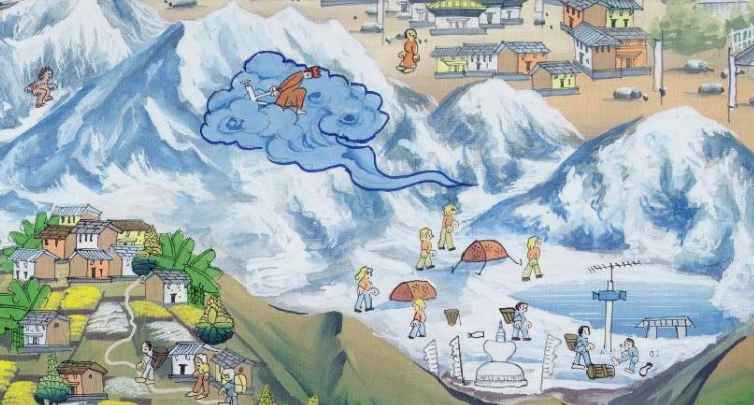
Why Rolwaling?
There are many beautiful valleys in Nepal, but none that are as likely to become the next big tourist destination.
Located just west of Khumbu, the home of Everest and most of the other giants, Rolwaling has languished in poverty and obscurity for decades due to a combination of factors. Its unusual east-west orientation kept it isolated from the north-south trade (between India and Tibet)that sustained the Khumbu Sherpas. Restrictive regulations prevented the development of tea-shop tourism. Virtually all able-bodied men and many women outmigrated seasonally or permanently in search of employment, leaving those who remained to survive on a deficient diet of potatoes and home-brew. In recent years, the specter of Maoist depredations (mostly exaggerated) further reduced tourist traffic.
Despite the tribulations, Rolwaling has unusually strong tourism assets:
- For both Hindus and Buddhists, Rolwaling is the most sacred valley in Nepal. The twinned peak of Gauri-Shankar, which forms the northern wall of the valley, is regarded as the abode of Shiva (another name for Gauri) and his consort Shankar. The Tibetan name, Jomo Tseringma, identifies the mountain with one of the most powerful goddesses in the Buddhist pantheon.
- According to Tibetan lore, Rolwaling is a beyul, or hidden sacred valley, set aside by the tantric saint Guru Rimpoche (aka Padmasambhava) in the eight century BC as a haven for dharma during times of persecution and upheaval. Unlike other beyuls such as Shambala and Shangri-la, which have existed as purely mythological or literary sites, Rolwaling is and has always been recognized by its inhabitants and by those of neighboring valleys as a sacred. This belief has contributed to an unusually strong cultural conservatism: until recently, for instance, it was unthinkable to slaughter an animal in the valley.
- Ecologically, Rolwaling is an exceptionally important valley. The rare east-west orientation has resulted in an unusual assemblage of floral ecosystems, and for many animals it serves as an important migrational corridor. Langurs, macaques, Tibetan bear, snow leopard, and other charismatic fauna are frequent visitors.
- Rolwaling is ground zero for yeti (abominable snowman) accounts. Eric Shipton's famous photographs of the trail of footprints in the snow was taken on Menlungtse glacier, just above Beding. Virtually all residents know people who have had encounters, and there is no doubt among the villagers that yetis exist.
- Although the total community numbers under 400, dozens of Rolwalingpa have distinguished themselves as climbers, including many who have multiple ascents of Mount Everest. The Everest Summiters Club is a new organization of nearly 40 Rolwaling Everest veterans committed to developing and preserving their homeland. Mountain Legacy has strong ties with this group, and we believe that one of our first projects will be a visitors center and museum celebrating the Rolwaling as the Cradle of Heroes.
- Khumbu Valley is separated from Rolwaling by Tashi Laptsa pass (19,000'), recognized as one of the most formidable trekking passes in the Himalayas. As most of the Everest trail is increasingly gentrified, the tougher routes will be sought out by more and more adventurers. We believe that the Khumbu-Rolwaling route should be developed as an alternate exit route from the Khumbu, allowing serious trekkers to return to Kathmandu without retracing their steps back to Lukla.
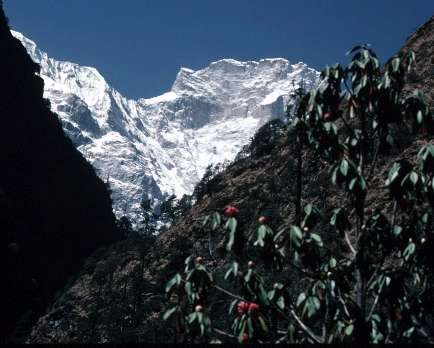
With all these attributes, it is inevitable that Rolwaling will be developed. We would like to see that this development proceeds in a sustainable fashion, which means that the local community must be organized and aroused to take advantage of economic opportunities before outsiders move in. One important step should be communal ownership of key trademarks. Rolwaling (and perhaps Cradle of Heroes) should be marketed internationally. A well-promoted sporting event would be a good first step. Later steps should include cottage-industry scale dried trekking food and equipment manufacture. Another project that we have been discussing with Everest Summiter members is the Summiters School, a mountaineering school for tourists taught and run by Sherpas. Most important, we would like the Cortland Nepal program to be the first stage of an international study center, the Rolwaling Mountain Legacy Institute. This institute would not only be a magnet for the best kind of "ecotourism" -- long term study -- but would also provide ongoing technical assistance for the Rolwaling community.
Why the "Long Trek In"?
Outside of Kathmandu Valley, Nepal is essentially a walking country. Roads and airstrips are innovations that hard-core trekkers regret. To see Nepal from the cramped seat of a lurching bus or the dicey prospect of a domestic flight, they feel, is hardly worth the visit.
The road to Jiri has clearly brought important economic benefits to the region, but it has also had negative impacts. Trekking tourism, which had brought hope to villages between Lamosangu and Jiri, collapsed. Even on the main trail from Jiri eastward, progress has been slow due to the displacement of leisurely trekking by rush-rush-rush fly in-fly out tours.
From the tourist's point of view, the long trek in has other advantages than the panorama of rural Nepal. The experience itself is transformative: many trekkers claim that it was more significant to them than actually reaching Everest. It is the hook that holds visitors, bringing them back for visit after visit.
The transformation is not only spiritual but also physical. Cutting across the topographical grain of the country means climbing and dropping thousands of feet repeatedly, a process that frequently gets many trekkers into the best shape they've ever been, and guarantees that they will not fall prey to Acute Mountain Sickness as they approach their final destination.
From the perspective of the Nepalese hosts, the long trek in maximizes contact between host and guests, increasing the likelihood that guests will feel a commitment to the host community and return repeatedly; some will even become "sponsors."
An Everest Classic trekking rally might revitalize interest in this uniquely Nepalese tourism asset. Making this a weight-carrying event would have other advantages. It would promote empathy for porters, the true athletes of Nepal; and it would promote a carry-your-own ethos, reversing the tendency to dehumanize locals as beasts of burden, and allowing more people to share the remarkable benefits of this form of recreation.
Contact
If you are interested in participating in Moving Mountains or have any feedback, contact Mountain Legacy Projects Coordinator Seth Sicroff at sicroff@gmail.com; 511 W. Green St., Ithaca NY, 14850 USA; (607) 256-0102.
|
[ Home ]
[ Update ]
[ Inside Moving Mountains ]
[ Commentary ]
[ About Us ]
[ Advertising ]
[ Join Us ] |
