Dance is Sport!

page M.001

 
[ Update ] [ Inside Moving Mountains ] [ Commentary ] [ About Us ] [ Advertising ] [ Join Us ]
[ Mountain Legacy ] [ Photos ] [ Blog ] [ Links ] [ Contact ] Bookmark and Share

Not only is dance sport, it is exactly the kind of sport that justifies the United Nations focus on sport as an appropriate tool for development and peace. In fact, it would seem that the only consideration that might explain the absence of dance from the Olympics is that there are so many dance traditions. If all were brought into the Olympic tent, there would be more events devoted to dance than to all other sports combined. (And would that be a terrible thing?)

George Bernard Shaw famously referred to dance as the vertical expression of a horizontal desire legalized by music. It is not surprising that women have, for whom foreplay is more important than it is to most men, have been more interested in dance. For many years, dance seems to have been stigmatized, along with singing, as feminine, or effeminate. That "coodies" mentality has been breaking down in the last few decades. Partly that is due to the popularity of breakdance and hip-hop music, which are distinctly unromantic and often blatantly misogynistic, and therefore more palatable to boys more concerned with appearing tough than with expressing horizontal desires.

At the same time, dance has been swept up into the Karate Kid - Rocky - Replacements genre of competitive sport films. Saturday Night Fever, Strictly Ballroom, Dirty Dancing, and other films have used dance as metaphor (and a catalyst for) personal and interpersonal growth, social progress, and idealism in general. More recently, the popular reality shows So You Think You Can Dance and Dancing with the Pros have shown and fomented a broad interest in dance as a disciplined, athletic, diverse, entertain, and attractive field -- and one that would be hard to define in a way that in any way distinguished it from other activities that have been characterized as sports.

Swing Kids vs Hitler Youth

As the film Swing Kids (1993) opens, the following words scroll by:

In the late 1930s there was a new movement on the rise among the teenagers of Hamburg, Germany. Its followers refused to join the Nazi youth organization, the Hitler Jugend - known as the H.J. They wore their hair long and were obsessed with American movies, British fashion and Swing music. They called themselves Swing Kids.

The movie Swing Kids is based on a historical phenomenon (see Wikipedia article). Swing music and dance were condemned by the Nazis as degenerate art forms, the spawn of blacks and Jews. Whether or not the movie is a fully accurate representation, the basic facts are not in dispute. There are few historical cases that better illustrate the potential of a recreational form to oppose social pathologies, and to align practitioners against militarism and for peace.

The Davis Swing Kids at the Telemark Showcase, May 16, 2009

Davis Swing Kids


Dirty Dancing

No One Puts Baby in a Corner

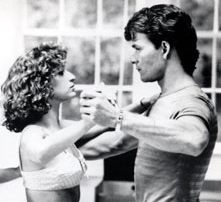
Of course Shaw's horizontal desire is everywhere evident in the ironically-named Dirty Dancing (1987), but the theme of personal liberation is subsumed into a social confrontation expressed in and resolved in the context of the idealistic 1960s. Here's a scene in which horizontal and social desires merge in dance: Breaking Frame...

dirty dancing

"This is my dance space. This is your dance space. I don't go into yours, you don't go into mine. You gotta hold the frame."
-- Johnny Castle to Baby

If you don't believe dance can change the world, you've probably forgotten the last scene of Dirty Dancing, when Johnny revolts against the oppressive structure of the Borsht Belt resort, liberates Baby from her over-protective father, and announces to the world:

"I'm gonna do my kind of dancing with a great partner, who's not only a terrific dancer, but somebody who's taught me that there are people willing to stand up for others no matter what it costs them. Somebody who's taught me about the kind of person I want to be."

All the best Dirty Dancing clips on YouTube have embedding disabled, but you can watch the last scene here. [Unfortunately, the clip stops before the climactic lift (representing interpersonal and cross-class trust and cooperation) as well as the triumphant strut-walk of the underclass and the final dam-burst when guests and workers all let their hair down in an multi-form chaotic dance of social progress.]

One more clip, for those of us who loved and found inspiration in the life and work of dancer and actor Patrick Swayze (August 18, 1952 – September 14, 2009):

My time in the Davis Swing Kids (~1994-1996) was incredibly valuable. I learned to be nimble on my feet and confident in social situations, thanks largely to this experience. Rock on.
-- Graham Freeman


The Davis Swing Kids is a dance team consisting of junior high and high school students. It was founded by Barbara Nicholas, proprietor of Barbara's Dancing Tonight, a ballroom and Latin dance studio located in Davis, California.


So You Still Think Dance is Not a Sport?


Contact

If you are interested in participating in Moving Mountains or have any feedback, contact Mountain Legacy Projects Coordinator Seth Sicroff at sicroff@gmail.com; 511 W. Green St., Ithaca NY, 14850 USA; (607) 256-0102.